



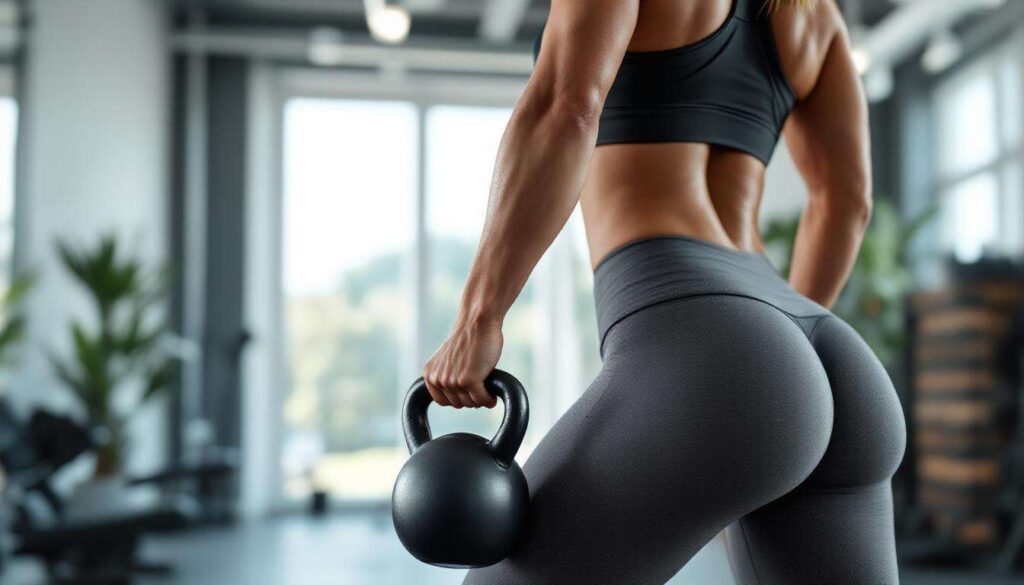
Building stronger, more powerful glutes doesn’t require an expensive gym membership or elaborate equipment. A single kettlebell and five targeted exercises can transform your lower body strength, enhance athletic performance, and improve everyday movement patterns. This versatile piece of equipment offers unique benefits that make it particularly effective for glute development, combining resistance training with dynamic movements that challenge muscles in ways traditional weights cannot replicate.
The benefits of kettlebells for glutes
Why kettlebells excel at glute activation
Kettlebells provide distinct advantages for glute training compared to other equipment. The offset center of gravity forces your muscles to work harder to stabilize during each movement, creating greater muscle engagement throughout the entire range of motion. This constant tension maximizes muscle fiber recruitment in the gluteus maximus, medius, and minimus.
The dynamic nature of kettlebell exercises promotes functional strength that translates directly to real-world activities. Unlike machines that isolate muscles along fixed paths, kettlebells require coordination between multiple muscle groups, mimicking natural movement patterns your body uses daily.
Physiological advantages of kettlebell training
Research demonstrates that kettlebell exercises generate significant metabolic demand, burning calories while building muscle simultaneously. The ballistic movements characteristic of kettlebell training create explosive power development in the glutes, improving sprint speed, jumping ability, and overall athletic performance.
- Enhanced posterior chain activation
- Improved hip extension power
- Greater core stabilization requirements
- Increased cardiovascular conditioning
- Better functional movement patterns
The compact design of kettlebells also allows for unrestricted movement through full ranges of motion, preventing the limitations often imposed by barbells or machines. This freedom enables deeper hip hinges and more complete glute contractions, essential for maximum muscle development.
Understanding these fundamental benefits establishes why kettlebells deserve a central role in any glute-focused training program, setting the stage for exploring the specific exercises that deliver results.
Essential exercises for powerful glutes
Kettlebell swing: the foundation movement
The kettlebell swing stands as the cornerstone exercise for glute development. This explosive hip hinge movement targets the entire posterior chain while emphasizing the glutes through powerful hip extension. Position your feet shoulder-width apart, hinge at the hips to grasp the kettlebell, then drive your hips forward explosively to swing the weight to chest height.
The key lies in understanding that arms merely guide the kettlebell while hip thrust generates all the power. This distinction ensures proper glute engagement rather than relying on shoulder strength. Perform 15-20 repetitions for 3-4 sets to build endurance and power simultaneously.
Goblet squat: depth and control
Holding the kettlebell at chest level in the goblet position creates a counterbalance effect that allows deeper squats with better form. This depth maximizes glute activation at the bottom position and throughout the ascending phase. The front-loaded weight also engages your core intensely, improving overall stability.
Focus on pushing your knees outward as you descend, maintaining an upright torso throughout the movement. This technique ensures the glutes bear the primary workload rather than shifting emphasis to the quadriceps.
Single-leg Romanian deadlift
This unilateral exercise addresses strength imbalances while dramatically increasing glute activation on the working leg. Balance on one leg while holding the kettlebell in the opposite hand, hinge forward at the hip, and extend your free leg behind you for counterbalance.
| Exercise | Primary Target | Recommended Sets | Repetitions |
|---|---|---|---|
| Kettlebell Swing | Gluteus maximus, hamstrings | 3-4 | 15-20 |
| Goblet Squat | Glutes, quadriceps | 3-4 | 10-15 |
| Single-leg RDL | Glutes, hamstrings, balance | 3 | 8-12 per leg |
Kettlebell sumo deadlift
The wide stance of the sumo deadlift places exceptional emphasis on the glutes and inner thighs. Position the kettlebell between your feet, adopt a stance wider than shoulder-width with toes pointed outward, then drive through your heels while squeezing your glutes at the top position.
Lateral lunge with kettlebell
This movement targets the gluteus medius, the muscle responsible for hip stability and the rounded appearance of the upper glutes. Step laterally while holding the kettlebell at chest level, sink into the stepping leg, then push back to the starting position using glute power.
These five exercises create a comprehensive glute-building program, but their effectiveness depends entirely on proper execution, which requires attention to specific technical details.
Technique and posture: keys to effective training
Hip hinge mechanics
Mastering the hip hinge represents the most critical technical skill for kettlebell glute training. This movement pattern involves bending at the hips while maintaining a neutral spine, creating tension in the hamstrings and glutes. Many beginners mistakenly squat instead of hinge, which shifts emphasis away from the glutes.
To practice proper hinging, place a broomstick along your spine, maintaining three points of contact: head, upper back, and tailbone. Bend forward at the hips while keeping these contact points, feeling the stretch in your hamstrings.
Spinal alignment and core engagement
Maintaining neutral spine position throughout all movements protects your lower back while ensuring optimal force transfer through the posterior chain. Engage your core by bracing as if preparing for a punch to the stomach, creating intra-abdominal pressure that stabilizes your spine during heavy loads.
- Keep your chest proud and shoulders back
- Avoid rounding or hyperextending your lower back
- Maintain a slight natural curve in the lumbar spine
- Look at a point on the floor several feet ahead to keep neck neutral
- Breathe rhythmically, exhaling during exertion phases
Foot positioning and weight distribution
Proper foot placement ensures maximum glute recruitment during exercises. For most movements, position your feet to allow your knees to track over your toes without caving inward. Distribute weight evenly across the entire foot, though emphasizing the heels during pushing movements enhances glute activation.
The tripod foot position, maintaining contact through the heel, big toe, and little toe, creates a stable base for force production. This foundation allows you to generate maximum power from your glutes without compensation from other muscle groups.
Perfect technique transforms exercises from merely moving weight into targeted muscle-building tools, but even flawless form cannot prevent injuries without proper precautions.
Preventing injuries during kettlebell exercises
Warm-up protocols
A comprehensive warm-up prepares your muscles, joints, and nervous system for the demands of kettlebell training. Begin with 5-10 minutes of light cardiovascular activity to increase blood flow and core temperature. Follow this with dynamic stretches that specifically target the hips, hamstrings, and glutes.
Effective warm-up movements include leg swings, hip circles, bodyweight squats, and glute bridges. These exercises activate the muscles you’ll use during your workout while improving range of motion.
Progressive overload principles
Attempting too much weight too soon represents the primary cause of kettlebell-related injuries. Start with a weight that allows you to complete all prescribed repetitions with perfect form. Only increase resistance when you can perform exercises with complete control throughout the entire range of motion.
| Experience Level | Recommended Starting Weight | Progression Timeline |
|---|---|---|
| Beginner | 8-12 kg | Increase every 3-4 weeks |
| Intermediate | 12-20 kg | Increase every 2-3 weeks |
| Advanced | 20+ kg | Increase as performance dictates |
Recovery and rest periods
Muscles grow during recovery, not during workouts. Allow 48-72 hours between intense glute-focused kettlebell sessions to permit adequate recovery. This rest period enables muscle repair and adaptation, preventing overtraining syndrome and reducing injury risk.
Listen to your body’s signals. Persistent soreness, decreased performance, or joint pain indicate insufficient recovery. Adjust your training frequency accordingly rather than pushing through warning signs.
With injury prevention strategies in place, you can confidently structure a training program that delivers consistent progress toward your glute-building goals.
Training routine: plan and progress
Weekly training structure
An effective kettlebell glute program requires 2-3 sessions per week, allowing adequate recovery between workouts. Structure your week to separate intense lower body sessions by at least one rest day or upper body training day.
Sample weekly schedule:
- Monday: kettlebell glute workout
- Tuesday: active recovery or upper body
- Wednesday: rest
- Thursday: kettlebell glute workout
- Friday: rest or light cardio
- Saturday: kettlebell glute workout
- Sunday: complete rest
Workout composition
Each session should include all five exercises, performed in a logical sequence that maximizes effectiveness. Begin with compound movements like swings and deadlifts when energy levels are highest, then progress to more technical unilateral exercises.
A complete workout structure: kettlebell swings (4 sets of 15-20), goblet squats (3 sets of 12-15), sumo deadlifts (3 sets of 10-12), single-leg Romanian deadlifts (3 sets of 8-10 per leg), and lateral lunges (3 sets of 10-12 per leg). Rest 60-90 seconds between sets for strength development.
Tracking progress and making adjustments
Maintain a training log documenting weights used, repetitions completed, and perceived difficulty. This record reveals patterns and guides progression decisions based on objective data rather than guesswork. Increase weight when you can complete all prescribed sets and repetitions with two repetitions remaining in reserve.
Understanding common questions about kettlebell glute training helps clarify remaining uncertainties and reinforces best practices.
FAQs on glute training with kettlebells
How quickly can I expect results ?
Most individuals notice improved glute strength within 3-4 weeks of consistent training, while visible muscle development typically appears after 6-8 weeks. Genetic factors, nutrition, and training consistency significantly influence individual timelines. Progressive overload and adequate protein intake accelerate results.
Can kettlebell training alone build significant glute mass ?
Kettlebells provide sufficient resistance for substantial glute development, particularly for beginners and intermediate trainees. Advanced lifters may eventually require additional loading methods, but a single kettlebell offers years of progressive training potential through exercise variations and increased volume.
What weight kettlebell should I start with ?
Beginners typically start with 8-12 kg kettlebells, while those with strength training experience may begin with 12-20 kg. Choose a weight that challenges you while maintaining perfect form throughout all repetitions. Starting conservatively prevents injury and establishes proper movement patterns.
How do I know if I’m activating my glutes correctly ?
Proper glute activation produces a burning sensation in the buttocks during and after exercises. Place your hand on your glutes during movements to feel muscle contraction. If you feel excessive fatigue in your lower back or hamstrings instead, reassess your form and potentially reduce weight to focus on technique.
Transforming your glutes requires only a single kettlebell and commitment to these five fundamental exercises. The combination of swings, squats, deadlifts, and lunges creates comprehensive posterior chain development that enhances both appearance and functional capacity. Proper technique, progressive overload, and consistent training produce remarkable results without expensive equipment or complicated programs. By prioritizing form over ego, allowing adequate recovery, and tracking progress systematically, you’ll build the strong, powerful glutes that support better movement, improved posture, and enhanced athletic performance in all areas of life.